Welcome to the gardens of the Château de Lanniron in Quimper. Located on the banks of the Odet River, the Lanniron estate served as the residence of the bishops of Quimper for more than six centuries .
Transformed into a Palladian-style residence in the 19th century, the château overlooks Italian-inspired French gardens created in the 17th century, which descend in terraces toward the Odet River. The gardens also feature a remarkable botanical collection established in the 19th century by the ancestors of the current owners.
After suffering significant damage, the gardens have now been partially restored. The 20 symmetrical flowerbeds, the two ponds, and the garden statues still need to be reconstructed.
Come explore this magnificent 45-hectare estate with its lush green landscapes with your family!
Through a scavenger hunt combining history and adventure, children ages 6 to 12 will uncover the six mysteries of the Lanniron Gardens alongside their heroes: Hermine de Kerret, her parrot Kalisto, and her brother René, who’s ready to embark on a long journey.
Continue your visit at our mini-farm, where chickens , sheep, goats, and donkeys thrive.
In the castle’s old stables, rediscover the joy of traditional wooden games with your family. Precision, dexterity, and speed will be essential!
Near the large farm, kids can have fun on the trampolines and in the inflatable structures: a giant soft mountain, a climbing tree, and a maze for endless games of hide-and-seek!
Along the way, merry-go-rounds, slides, swings, a spinning ride, and a zip line will delight the little ones at our two playgrounds.
Don’t hesitate to use the pedal cars to quickly explore the estate’s paths.
Finally, come discover our Trampôforest adventure course among the treetops of the ancient oaks in Neptune Woods.
Self-guided tour of the historic gardens
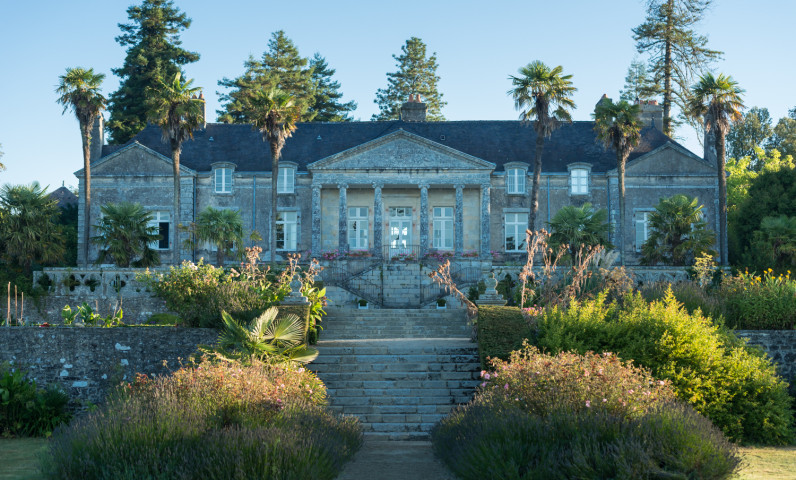
Facade of the castle
The castle's current facade dates from 1823, following renovations by Emmanuel Harrington to give it a Palladian style.
This façade replaces the 15th-century main building, to which a west wing had been added in the 1760s.
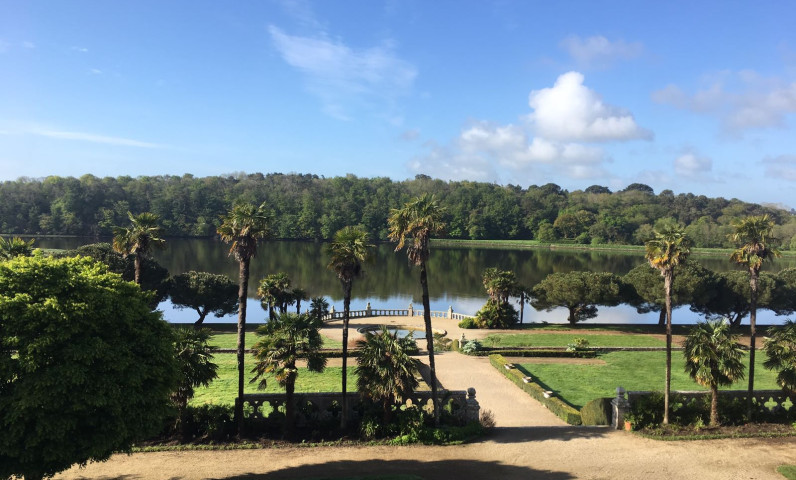
Terraces
Fully restored, the layout of the terraced gardens is of rare significance for the period in which it was built, the 17th century.
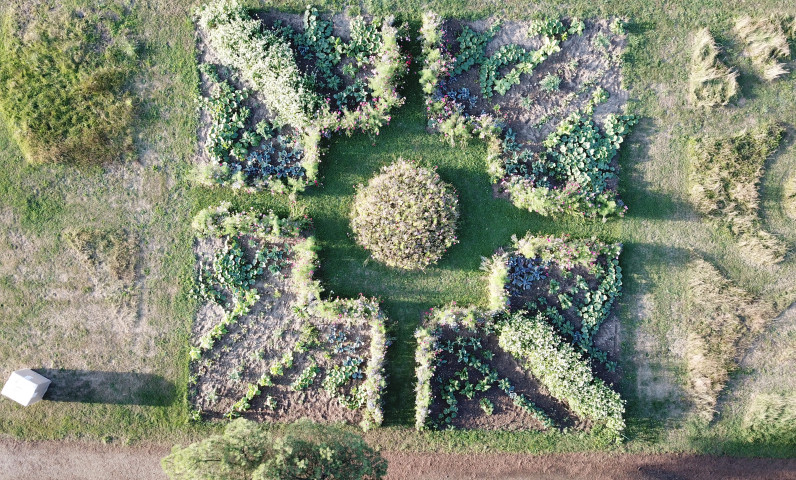
Vegetable patches
The vegetable garden plots have been undergoing restoration since 2018. The decision was made to restore the garden beds gradually.
The first two plots were restored as vegetable gardens in 2018 on the third terrace, followed by two more in 2019.
In 2020, the number of garden beds on the third terrace was increased to six.
The irrigation system for this terrace was installed, and the first espalier fruit trees were planted along the wall between the second and third terraces.
In 2023, the last two flowerbeds on the third terrace and the central esplanade were restored.
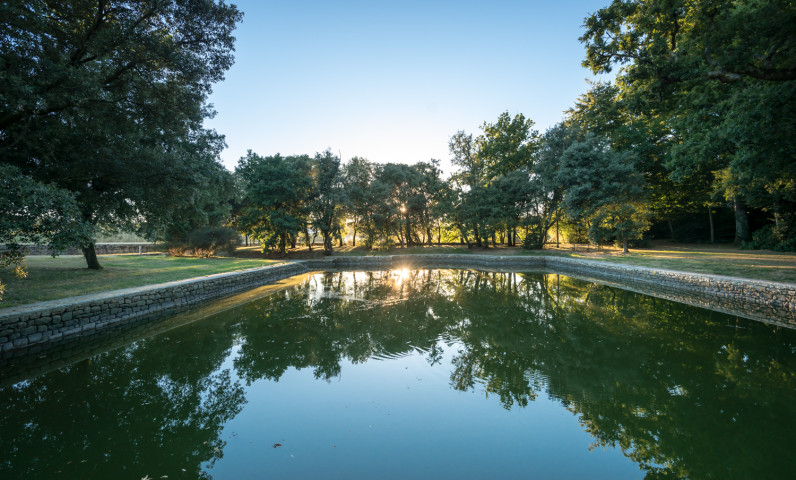
Neptune basin
This basin had gradually fallen into disrepair over time, and its edges had collapsed. Very small remnants of the wall were still visible before its restoration.
In the center of the basin stood a pedestal bearing a statue of Neptune, the god of the sea, perched on a dolphin, and a fountain spouted water from the statue.
Here again, symbolism played a role in the choice of this statue: Neptune, the god of the sea, was chosen for this basin because it was fed by the Odet River, which itself is subject to the influence of the sea at high tide. At high tide, the sea would flood the Odet River; then, through a canal, this saltwater would flow into the basin, where it was held back by a drain plug until the next high tide. Today, it fills up again during high tides when the valve is opened.
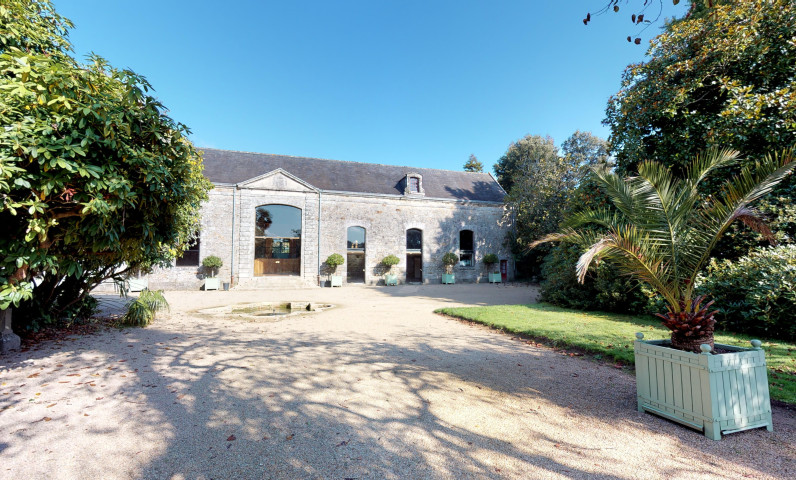
Facade of the Orangery
Built as an extension of an earlier building that stood perpendicular to it—traces of which can still be seen in the walls—the orangery was constructed in the second half of the 18th century by Monseigneur de Farcy de Cuillé. The pond in front, known as the “double mirror” pond, is the only one remaining from before the French Revolution.
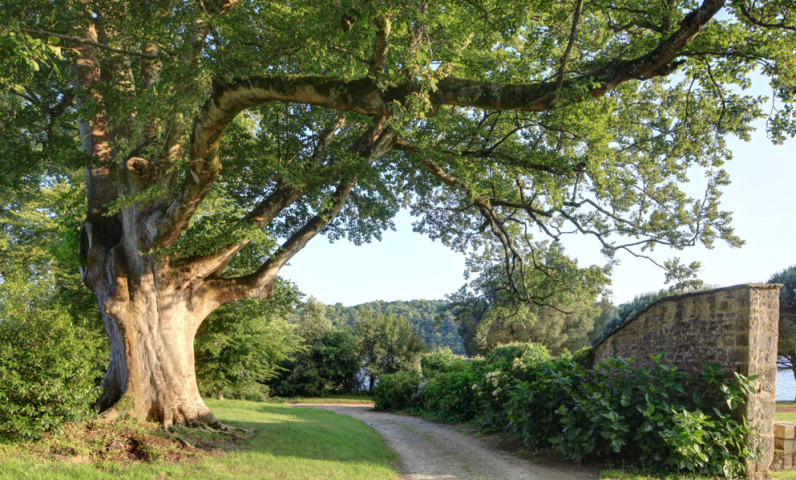
Arboretum
The Arboretum was gradually established in the 19th century, first by Hermine de Kerret and then by her daughter, Geneviève de La Sablière.
It is important to note the significance of Brittany in the development of arboretums, as the region’s oceanic climate allows many exotic varieties to thrive.
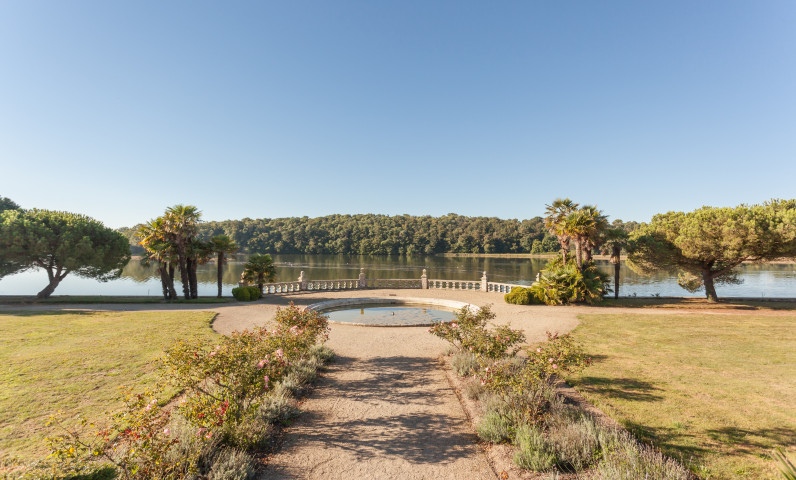
Dolphin Basin
A central feature of the gardens, the Dauphin Fountain—which was destroyed during the French Revolution—was restored in 2005.
A Dauphin once stood in the center of the pond, from which a water jet about 5 meters high shot up.
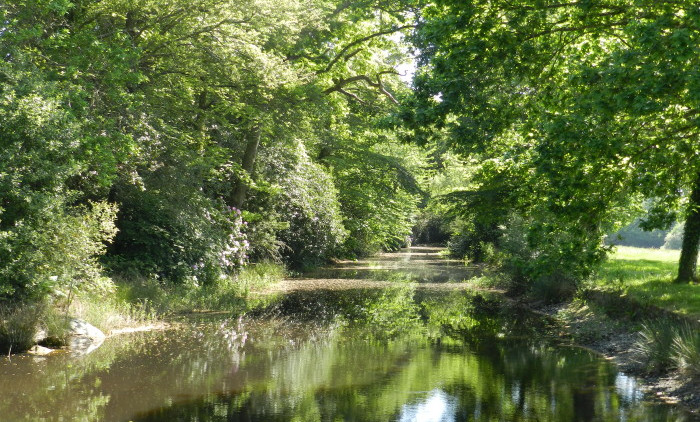
The large canal
The canal, built in the 17th century, served both decorative and functional purposes.
Decorative, thanks to its large canopy of greenery—270 meters long, 12 meters wide on one side, and 4 meters wide on the other. This design creates a sense of depth that makes it appear even longer. It was functional because, fed by a stream, it used gravity to supply water to the ponds on the terraces.
Neptune wood
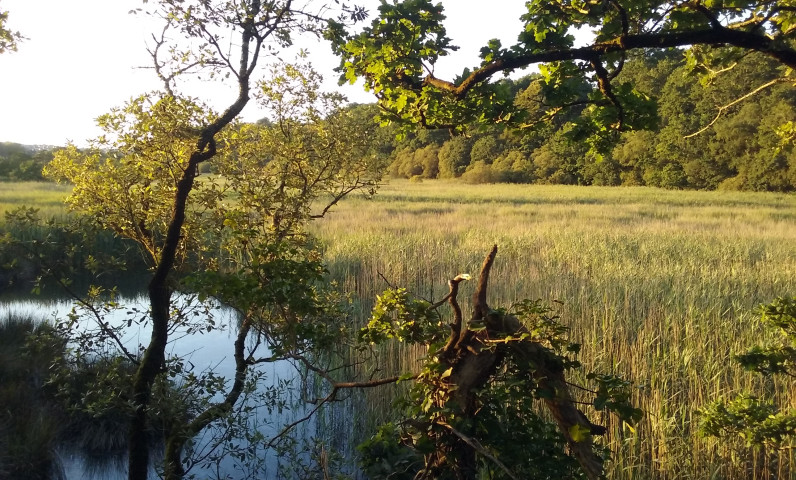
The Neptune Woods trail takes you on a 1.3-kilometer walk along the stream to the fountain, then continues to the old guardhouse before returning along the dike, where you’ll walk alongside the Odet River while enjoying a unique view of the reclaimed land—a polder created starting in 1839 by Charles de Kerret.
Park pathways
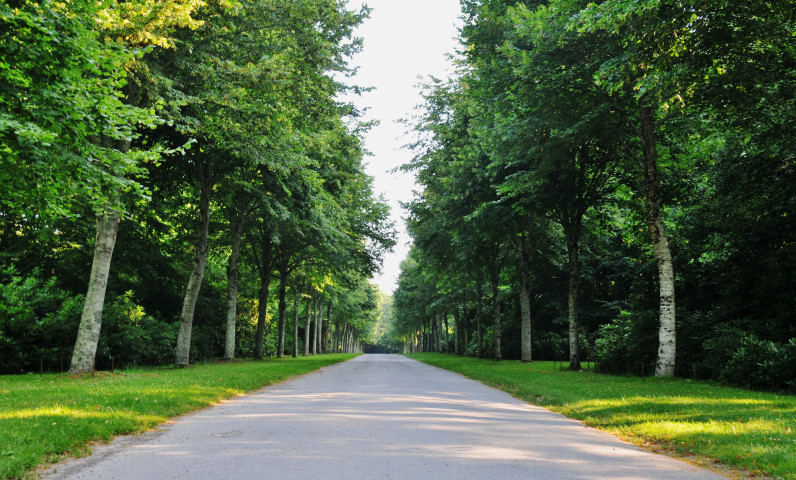
To reach the gardens, you’ll have the opportunity to stroll along the estate’s paths. First, you’ll take Kerbabic Drive, lined with old oak trees planted in the 18th century by Monseigneur de Farcy, and then you’ll head down the main avenue, which was replanted with linden trees after the 1987 hurricane.